

By Christina Swanson, BA, CHN
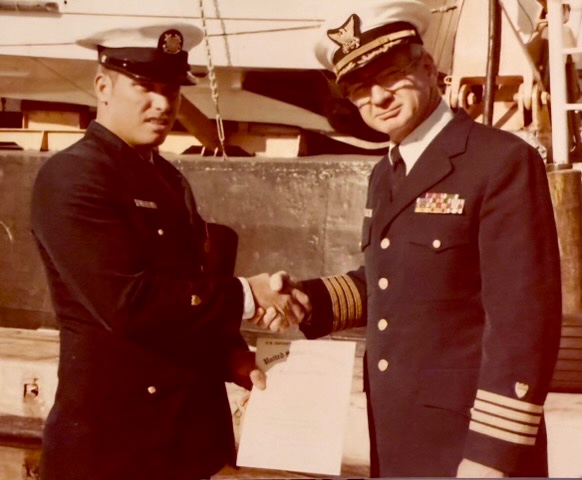
From a fireman in the Coast Guard to a firefighter lieutenant EMT at a naval base, he’s played a role in supporting and saving lives throughout a 31-year career.
Raised in the San Marco area of Jacksonville, FL, David Warren Durban was the captain of his high school’s swimming team, and the oldest of three sons. He had a mentor that he stayed in touch with until his recent passing, George McCall, who was in the Army’s 82nd Airborne during WWII and was awarded the Congressional Medal of Honor.
“He would break out his albums and show me all the places he fought and medals earned,” said Durban. “He told me to make goals and stick with them, to always look forward, and to stay out of trouble.”
After graduating from Wolfson High School in 1976, Durban started working for W.W. Gay Plumbing, a company where a lot of his family was part of all the way back to his grandfather. Its where one of his brothers would eventually retire as a vice-president. But for him, there was an incident and he left after only six months.
One afternoon while sitting on the beach on the Ponte Vedra coastline, he watched a 41-foot Coast Guard rescue boat save some fishermen whose boat had quit running, pulling them out of the breakers, when he thought he’d like to help people in this way.
Joining the Coast Guard in 1978, his friends had given him a party with a Playboy magazine to take with him to bootcamp at Cape May, NJ. While unpacking, his chief saw the Playboy that got him a “ration of hell” and was quickly confiscated.
Initial classes were in the 15-meter pool to learn survivor techniques, including how to create a make-shift life preserver out of jeans. Then on to learning how to tie knots and wrap pipe, including methods of tying things down on the ship, and then to fire arms training where he qualified on the M-16 rifle.
While on the firing range, something surprising happened when a guy next to him started pointing a 45-caliber pistol toward Durban’s head rather than toward the gun range. One of the sergeants came over and was able to get the gun from him. Needless to say, he was kicked out of the Coast Guard.
The highlight of bootcamp for him was being selected to be one of the honor guards of Cape May for their Christmas parade.
Durban’s first orders were as a Fireman on the Coast Guard Cutter Dallas, stationed at Governor’s Island, NY, in the Hudson River across from the Statue of Liberty. As a Fireman, he worked in the engine room assisting the machinery technicians and electricians with operating and maintaining the ship’s engines, auxiliary equipment, and hull systems.
“It was exciting for this Jacksonville kid to be transported from South Manhattan to Governor’s Island on a ferry,” said Durban.
During the 1.5 years on the Dallas, they were deployed to the Caribbean on a drug enforcement patrol. During one patrol, they came across a shrimp boat near Puerto Rico, that ended up being stolen and was hiding 15 tons of marijuana. The criminals on the boat refused to stop and it wasn’t until his unit mounted their machine guns and threatened to fire that they could seize the boat. Their boat was turned over to customs.
The Dallas continued exploring the Caribbean and ended up in Curassow Island near Venezuela to aide another cutter that was being shot at by drug runners. When they headed back to New York, Durban discovered a seaman smoking marijuana in the head, who was on the detail of removing high explosive munitions off the boat, and reported him to his division officer. “After the guy was taken off the boat, the division officer told the whole crew that I had saved everyone from the possibility of an explosion and everyone dying and that I was a hero for reporting him.”
Next, Durban attended damage control school to learn how to repair the ship in case of flooding, and how to inspect fire-fighting and self-contained breathing equipment.
His next adventures were on the Cutter Sweetgum, a buoy tender, where they refurbished the lighted buoy cans and nuns (not lighted) in the surrounding oceans and rivers, from Savannah to Cape Canaveral, working from Coast Guard Base Mayport.
Servicing them was a huge undertaking where a crane would pull them out of the water and cradle the buoy between railroad ties on the deck. A steel machine kept the chain from going back into the river and would bring up the 100,000-pound rock that anchored it and hold it on side of the boat. Then they could replace the rusted chain, scrap barnacles off the buoy and paint it, and replace the chemical batteries that lasted a year. Then there was the task of having to check for exact buoy placement before putting them back. Durban did this for two years, until 1982, when completing his four years of active duty.
One time, they transported a monster 50-foot National Oceanic and Atmospheric Association buoy from Mayport to the Florida Keys where they had to weld the shackles to the buoy’s chain in order to transport it. On another mission, the Sweetgum serviced buoys in the area from Gulf Port, MS, to Brownsville, TX, after the buoy tender Blackthorn had a collision with a super tanker and sunk, killing 60 Blackthorn crew.
Leaving active duty, Durban was hired as a correctional officer for the State of Florida Department of Corrections at the Lawtey Correctional Institute, a minimum-security prison with open bay dorms. During his two plus years there, he saved an inmate’s life from choking using the Heimlich maneuver.
The main thing a correctional officer learns in handling inmates is care, custody and control. “Care as in their health, control is keeping them safe and custody is being able to place them in a restrain hold,” said Durban.
All the while, Durban joined the Coast Guard Reserves which was attached to the Marine Safety Office Jacksonville on Talleyrand Avenue, (but has since moved to Arlington Expressway), where he served for nine years. On some of his two-week deployments, his unit took care of security around the launch pad at Cape Canaveral near Mosquito Lagoon when the Space Shuttle Discovery was there.
Other times, his unit helped damage controlmen at Mayport with basic repairs from plumbing to repairing ship hatches. On his last deployment, Durban served in Yorktown, VA, going to Port Security School, which involved securing vessels for safety while off-loading hazardous materials.
After correctional officer work, which gave him ulcers, he joined the firefighter team at Naval Air Station Mayport. It was his home for 27 years from July 1985 until December 2012. Starting as a trainee, he retired with the rank of Firefighter Lieutenant EMT, and earned numerous additional certifications from hazardous materials technician, to rescue boat coxswain, to fire truck pump driver and operator, and airfield firefighter.
“Our overarching mission was to be available to assist any event on the airfield within two minutes,” said Durban. This was possible because there is always a “hard stand” or firetruck being manned in four-hour shifts on the airfield, as part of their emergency response duties, in case there is an aircraft incident needing help.
It was the 1980s, before Fire Departments were part of the 911 system, so folks would be calling fire houses directly. They were always on watch with three phones: one was to the commanding officer on the base, the second one was to the dispensary in case they were needed, and the third was to the base’s air traffic control tower.
There were many events, but one that stands out was the day a helicopter crashed behind the pistol range on base and Durban dispatched the airfield firefighting trucks. Just 15 minutes later, a propane tank exploded off-base at a construction site requiring the combat trucks to rush there. As he was the only one left at the firehouse, he called the commander and shut down the airfield. When everyone returned, he was commended for his quick actions.
“Being part of the Coast Guard taught me that life is precious and instilled in me to protect life first and property second,” said Durban. “I look at events differently knowing I have the skills to save someone’s life in an emergency and that is a good feeling. Putting God first and appreciating my biblical studies growing up at Southside Methodist Church has been the backbone of all I’ve deemed important in my life.”