

By Christina Swanson, BA, CHN
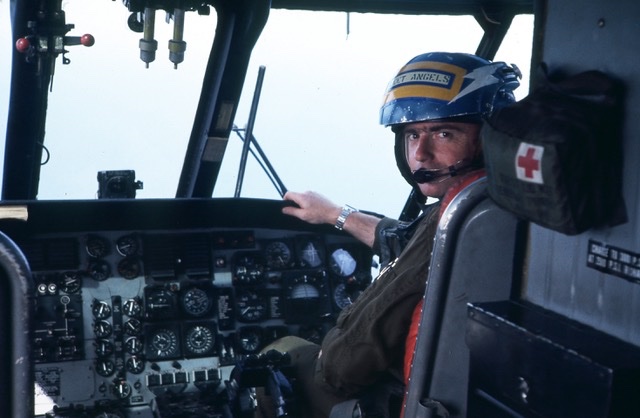
A naval aviator for 21 years where he can proudly say his take-offs equaled his landings, his rich career brought him many unique experiences. From flying search and rescue missions off the USS LaSalle, to moving cargo on the CH-46 Sea Knight, to enforcing the Camp David Accord Peace Treaty as a United Nations Peace Keeper, Veteran Douglas MacDonald has contributed to what most folks can only imagine.
With a dad, affectionately called Mac, who served in the Navy for 33 years, a young Doug was kind of prepared for service with the family moving every few years, growing up in such varied places as Rhode Island and the Philippines.
During one of his dad’s tours, the family had to stay behind for six months and the family lived with his grandma, which gave him the chance to play with Nixon’s two daughters who lived near-by. Although MacDonald attended three high schools, he ended up in Florida, graduating from Eau Gallie High School in the Eau Gallie area of Melbourne, FL, in 1966.
While attending Florida State University, majoring in business management, in his junior year he applied and was accepted for a Navy reserve program that would result in attending aviation officer candidate school at NAS Pensacola, FL. After this 16-week training, MacDonald was off to flight school, where after his first solo flight was commissioned as a naval aviation officer. At this time, he also married his high school sweetheart, Lynda.
As a naval aviation officer, MacDonald got to select which aircraft he would like to fly: jets, fixed-wing or helicopters. What was unique about picking helos was you also got to fly fixed-wing, so he asked for helicopters and got his wings on November 10, 1972, which also happened to be the Marine Corps’ birthday.
His first assignment was at Lake Hurst, NJ, flying DC-3 cargo planes. “This WWII era transport was a challenge to fly but also very rewarding,” said MacDonald.
After three years, he received orders to NAS Jacksonville, FL, to fly with a search and rescue helicopter squadron, deploying off various ships out of Jacksonville. “Anytime there were flight operations on the aircraft carrier, we were airborne, so if something happened to one of the jets, and the pilot would have to eject, we could get him right away,” said MacDonald. He remembers that he was fortunate that his first officer in charge had just come back from Vietnam, and was very calm and helpful, the kind of leader everyone hopes for.
There was a unique assignment that happened on his 29th birthday and earned him a special award, the winged “S” award for making a rescue at sea in a Sikorsky aircraft. As the aircraft commander, they were airborne off the USS LaSalle, flying over the Persian Gulf, when he got a call from the ship that a crew member on a civilian freighter had fallen and broke his back. They asked him and his flight crew to find the ship, rescue the injured person and take him to the hospital.
“We went back to our ship to pick up our ship’s doctor, went out and found the freighter, couldn’t land on it so had to find a place to hover, lowered the rescue hoist with our crew man and then lifted the injured person into the helicopter,” said MacDonald. “While inside, our doctor helped him while he was being flown to the nearest hospital.” It was his first rescue at sea and something that was honored by Sikorsky by this special award. Sikorsky is the name of the guy who invented this aircraft, globally renowned for engineering the world's first mass-produced helicopter.
For the next four years he worked as a Navy recruiter working with colleges in Oklahoma City, OK. “Sometimes an applicant would call me as they were getting their commission,” said MacDonald. “That kind of affirmation was a nice, rare bonus to my duties.”
For MacDonald’s last 10 years he would operate from Norfolk, VA, with varied assignments. First, he was flying the CH-46 Sea Knight helicopter, unique with their two main rotors that rotate in opposite directions, making them very maneuverable. Affectionately known as the "Phrog," this aircraft was loud, vibrated heavily, and was a physically demanding experience requiring continuous stick-and-rudder piloting. Here he worked with supply ships moving cargo for the fleet.
Next, he was a Command Center Senior Watch Officer, dealing with disbursing highly classified information as it came in. “We were responding to world-wide issues that would come up.”
His next assignment was the most interesting of his career and was a learning experience in many ways ensuring the Camp David Accord’s established demilitarized and limited-force zones in the Sinai Peninsula were being upheld.
This one-year assignment was as a United Nations Peace Keeper where he spent six months in the Saini Dessert of Egypt and then six months in Golan Heights, Israel. “We were the eyes and ears for the United Nations ensuring that these two countries were staying peaceful with no fighting or build-up of weapons,” said MacDonald.
Working along-side peace keepers from a variety of countries, such as the Soviet Union, Germany, Denmark and Sweden, they would patrol routes and engage the public for eight-day schedules throughout the area in a huge white jeep with “United Nations” painted on its sides.
During his time in Egypt, one of the outposts he was monitoring also contained Saint Catherine's Monasteryand so MacDonald got the chance to visit there. Built between 548 and 565 CE, it is the world's oldest continuously inhabited Christian monastery and houses the biblical Burning Bush. Working with so many different country’s peace keepers so closely, he was able to learn attitudes and outlooks that few Americans would have the chance to experience.
During his time talking with a soviet army captain, they got to know each other on a personal level and he was surprised to learn that he had no concept of having freedom to make life choices. “He insisted that the government tells you what you are supposed to know and believe and he couldn’t understand that we can choose our life,” said MacDonald. “What was so intriguing about this job was we could talk to the other officers, share what America is all about and learn what it’s like to be officers in other countries.”
Final assignment at NAS Norfolk was as a Security Officer for three years, where he ensured the safety and security of the naval air station until retiring in 1992.
Staying in Norfolk for 37 years, 19 of those years was working for Harris Connect, a company that kept nonprofits’ data bases updated so they could communicate with their associations and contributors. Starting out as a phone communicator, MacDonald would soon become an account manager working with a specific group of nonprofits.
“I worked mostly with military associations located in Washington, DC, and it was enjoyable to meet different groups, figure out ways we could help them, and to experience the culture of Washington,” said MacDonald. “There are so many different neighborhoods within the area.”
He lives by the words, “Be honest in what you do. If you didn’t know it already, you certainly will learn it in the military.”
He and his wife moved to Jacksonville five years ago because his wife has two sisters in South Florida and his son married a girl from Jacksonville. His son, Scott, is a 3rd generation Naval officer and 2nd generation Navy pilot so he likes to say “our son joined the family business.”
His faith has been the mainstay of his life saying, “If I miss church for even a week, I feel off-centered as I need that renewal and fellowship with like-minded people. I also feel it is a huge accomplishment to raise a child that continues their faith as an adult. My faith permeates everything I do.”