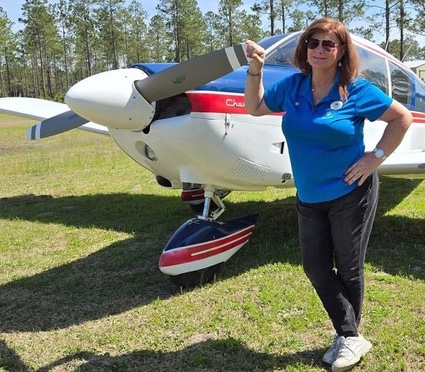
They say less than one percent of the population will ever experience a sunset or sunrise from a Navy ship. She had the fortunate experience of witnessing such a sunrise during a simulated NATO exercise of an amphibious assault that was like a techno-color, action-packed, movie scene.
As a young Marine helicopter crew chief back in the 80’s, it was an experience Veteran Stephanie Irvin will never forget. “As the lead helicopter of the assault off the coast of Carboneras, Spain, I saw the criss-crossing of attack helicopters above me, jet fighters flying above them, the array of multi-national ships in the Mediterranean, and amphibious assault ships spitting-out amtracks while attacking the beach,” said Irvin. “Having a front-row seat in a simulated NATO beach invasion was truly a once in a lifetime experience. As a crew chief, I had more than a bird’s eye view as I could watch all the action, not only in front of me, but all around and behind.”
As a youngster growing up, Irvin looked-up to her Army drill sergeant dad, learning about life living in areas such as Georgia, Germany and California, and was lit-up with a passion for cars and airplanes. Fixing cars at a young age with her dad and active in the Civil Air Patrol and ROTC, Irvin was destined to play a role in all aspects of mechanics and aviation.
They did everything together, as this tomboy’s first job was working at a gas station back when pumping gas, washing windows and making change, were still provided services. It was all to save up to be one of the first in her high school to have her own sweet ride, a 1964 Ford Falcon Sprint Convertible with a 289 engine.
“Because my dad always called me ‘Champ,’ no matter where I ended up, it made me remember to do my best to live up to how he saw me,” said Irvin.
A few years later, when Irvin was a new Marine at Parris Island boot camp, she was barely hanging on during their first run of 3.5 miles, when she heard the drill instructor say, “One more time.” “Yet somehow, I did it, and from that point on, I realized there is nothing I can’t do,” said Irvin. “It got me through boot camp and made an impact on the rest of my life.”
After high school, this Who’s Who in America High School student was selected to go to the Air Force Academy, but her love of aviation had her choosing Embry-Riddle Aeronautical University instead. That’s because she could earn her private pilot’s license while studying aeronautical science. She was counting on the alternate scholarship she had won to being honored, but funding was canceled. Working two jobs and living out of her car during the week to survive, money ran out and she had to return home to Orlando.
Now attending Florida Technological University (FTU) while still in Air Force ROTC, more failed promises ensued. Her determination to fly for the military always in the forefront, first, former President Nixon cut allocations for pilots in the Air Force and then, when Irvin applied to go into the Army as a helicopter pilot, that didn’t come through either after months of waiting.
Impatient, Irvin joined the Marines in 1976 as a jet engine mechanic, and while in Memphis they were looking for volunteers to work helicopters, so she signed-on as a crew chief. Graduating first in her class, her first tour was seven months in the Med aboard the USS Guam LPH-9, traveling from Spain to Sicily.
While flying over the Med, Irvin noticed the helicopter’s main oil line hanging out of the transmission. “I grabbed the oil line and literally held it inside the transmission with hot oil burning my hand, arm, down my side and leg,” said Irvin. “I happened to see a Navy ship with a landing platform and told the pilot we have to land. If I hadn’t, we would have all died. Fortunately, the ship had a machine shop and made a new brass fitting to hold the oil line into the transmission. I have it to this day because brass wasn’t an approved metal and it was changed out to the right type later-on.”
Then, something else pretty amazing happened, showing Irvin’s innate spunk. “Meaning a lot to me, this brass fitting was on my bunk when I saw the maintenance officer take it, and, without thinking, I tackled him from behind, got it back and told him, ‘This is mine sir.’” “I had the reputation as an exceptional marine or he would surely have court martialed me.”
Other tours included survival training in the Georgia mountains, (learning how to perform at night in the cold with snow and ice), SERE (survival, evasion, resistance and escape training required for air crew) at Cherry Point, cross-country flights, parachute training with the SEALS, flying external loads from jeeps to cannons, and shooting 50-caliber machine guns, as crew chiefs must be qualified gunners.
After being honorably discharged in 1980, Irvin went back to FTU full-time while an attendant at a gas station. With dwindling funds again, she joined civil service at Jacksonville Naval Aviation Depot (now Fleet Readiness Center Southeast) starting out as an aircraft mechanic. For more than 33 years, she has contributed to the fleet readiness of a host of aircraft as they changed throughout the years: the A-7 Corsair 2, F-14 Tomcat, F-18 Hornet, F-18 Super Hornet, EA-6B Intruder, SH-60 Seahawk, T-2 Buckeye, S-3 Viking, P-3 Orion, and the T-6 Texan 2.
A mechanic for 20 years, an aircraft examiner and evaluator for one year and an aircraft quality assurance specialist for 12 years, her skills had her traveling the world inspecting aircraft and working ordinance as she was one of few ejection-seat certified.
Retiring from civil service in 2013, Irvin has really never left the aviation world and works on aircraft today, either on her own Piper Cherokee 180, named Roxy, or helping other fellow pilots at Herlong Airport. She even built her own experimental aircraft, a Challenger II Clipwing Special that, of course, she modified with a larger engine and wing tanks. She is a licensed Airframe and Powerplant mechanic, (A&P), with an Inspection Authorization certification, as well as a pilot with a commercial license.
Irvin enjoys the challenges of keeping her airplane current while flying for various causes to help others, such as with Pilots N Paws. Here, volunteer pilots transport rescue animals to new forever homes. She promotes women in aviation fields through serving with various organizations, such as The Ninety-Nines International Organization of Women Pilots that has chapters world-wide. She has also helped out several pilot training and aircraft maintenance companies at Herlong Airport as a manager and lead mechanic since 2013.
She is most at home being among other pilots or being with her church family, as her faith has buoyed her through many struggles and challenges. “Being from an aviation family, (her granddad, a barnstormer who, in 1938, was the first to fly airmail from Frederick, MD to Baltimore), nothing matches the feeling of flying and how it promotes confidence and a real sense of freedom. And nothing is more important than my faith and how my church is at the center of all that I do.”